

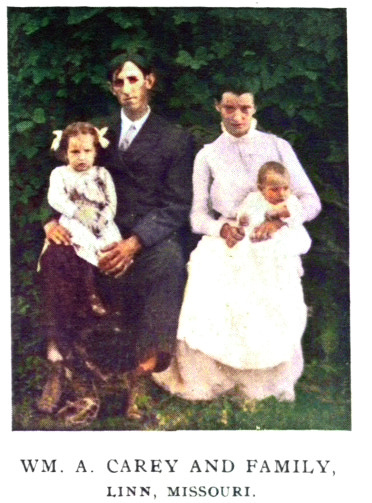
Wm holding Marybelle, Dora holding Delphia
Osage
County is available for adoption.
If you have a local connection to Osage County or an interest in Missouri in general,
Please consider joining the MOGenWeb as a County Coordinator.
Requirements are simple, peruse them here.
https://mogenweb.org/moccguide.htm
MOGenWeb Policies and Procedures
https://www.mogenweb.org/pol-pro.htm
Contact the State Coordinator if you are interested.
In addition:, we would appreciate any contribution that you would like to make to this
site: biographies, obituaries, birth, marriage, death info, grave info, photographs....etc
Osage
County, Missouri
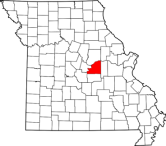
Osage County was organized on January 29, 1841, during Missouri’s early period of inland settlement. The region takes its name from the Osage River, whose wide bends, fertile bottoms, and timbered hills shaped both Indigenous travel routes and the paths of pioneer families arriving from Kentucky, Tennessee, Virginia, and the Carolinas.
Early Settlement
Settlers began moving into the area in the 1820s and 1830s, establishing small farming communities along the Osage and Maries Rivers. Early families left documentary trails in land patents, church records, probate files, and township histories that remain central to genealogical research today.
Selection of the County Seat
When Osage County was formed, officials chose Linn as the county seat. Its central location and reliable access to transportation routes made it the practical choice for courts, administration, and trade. Linn has remained the county seat since its establishment, serving as the county’s governmental and archival hub.
Growth and Community Development
Throughout the mid‑19th century, towns such as Chamois, Freeburg, Westphalia, and Argyle grew around mills, ferries, and later railroad lines. Significant German immigration in the 1840s–1860s shaped the county’s cultural and religious landscape, leaving behind rich church registers, cemetery records, and community histories.
Agriculture remained the backbone of Osage County’s economy well into the 20th century, with many families maintaining multi‑generation ties to the land. Today, the county’s courthouse records, cemeteries, newspapers, and long‑standing rural communities offer valuable resources for genealogists tracing families across central Missouri.